


Public Opinion Study
The Verdict Filipinos Would Give - Wave 2
Executive Summary
This paper reports the second wave of Pulso Intelligence's weekly tracking of Filipino public opinion on the impeachment of Vice President Sara Duterte. Wave 2 was fielded August 17–23, 2026 and is compared against Wave 1 (August 10–16, 2026). Two instruments are covered: a national reading of whether the public believes the Vice President is guilty, and a scorecard rating the twenty-one senator-judges hearing the case.
The headline finding is a small but one-directional shift toward a guilty verdict, concentrated among the most news-engaged Filipinos and among specific regions, against a backdrop in which a plurality still favours acquittal and doubts the fairness of the proceedings.
KEY FINDINGS
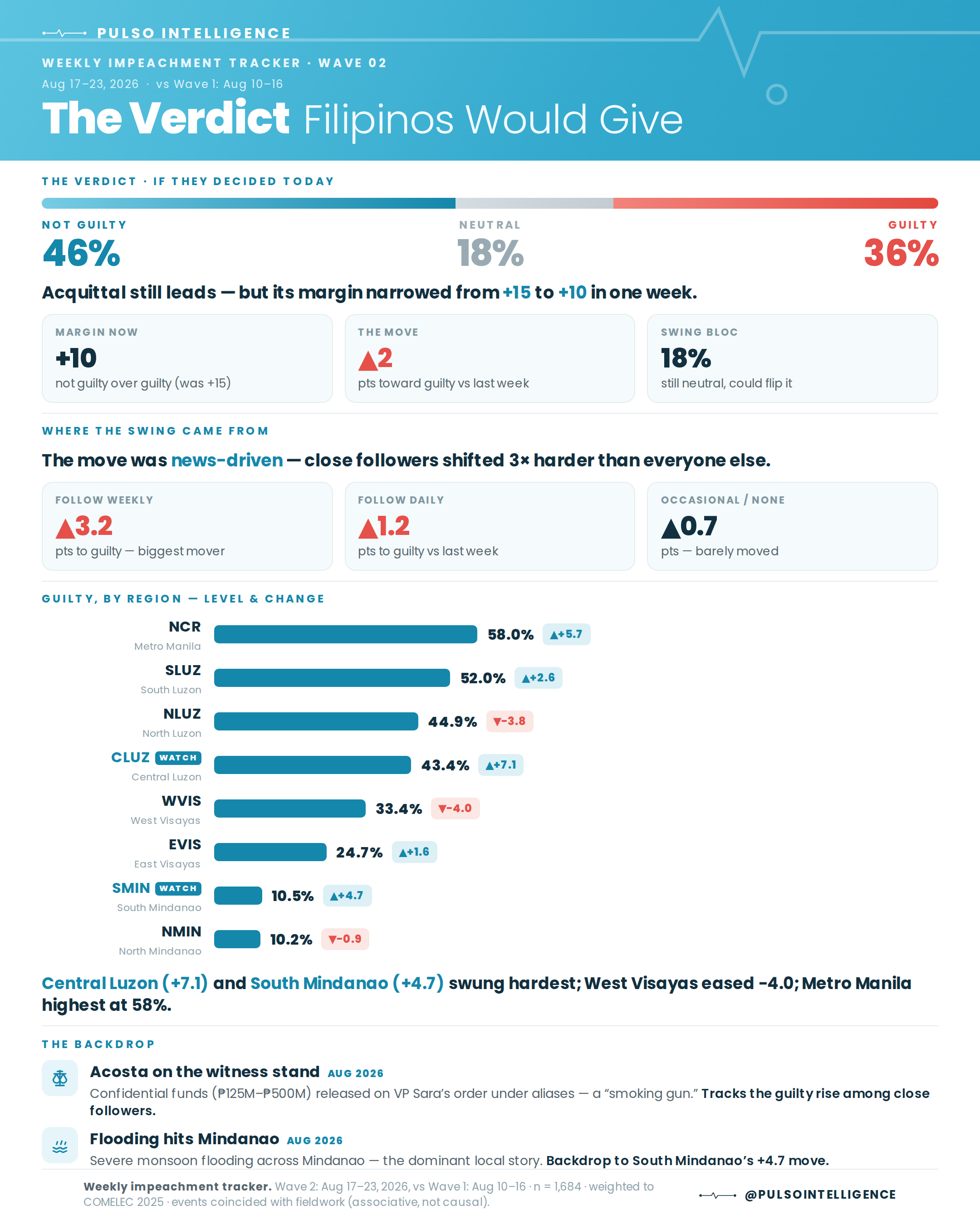
- Acquittal still leads, but by less. “Not guilty” fell from 48.5% to 46.2% while “guilty” rose from 34.3% to 36.3%. The acquittal lead narrowed from 14.2 to 9.9 points in one week; the mean guilt rating rose from 2.73 to 2.79 on a 1–5 scale.
- The move was news-driven. Filipinos who follow the trial weekly moved +3.2 points toward guilty and daily followers +1.2, versus roughly +0.7 among those who follow occasionally or not at all.
- Central Luzon, Metro Manila and South Mindanao moved most. Guilty sentiment rose +7.1 points in Central Luzon, +5.7 in Metro Manila and +4.7 in South Mindanao, while West Visayas (−4.0) and North Luzon (−3.8) eased. Mindanao remains strongly acquittal-leaning in absolute terms.
- Women and older voters lean more toward guilt. 40.6% of women say guilty versus 31.9% of men; by age, sentiment is U-shaped — 46.0% of those 51+ and 41.8% of 18–30-year-olds say guilty, against just 31.6% of those 31–50.
- The public is unconvinced the trial is fair. Only 25.6% say the Senate is conducting the trial fairly, against 36.7% who call it unfair and 37.7% neutral — with perceived unfairness highest in Mindanao.
- No senator-judge clears the midpoint. On the new 1–5 scale, the highest-rated senator (Francis “Chiz” Escudero) scores 2.99 — just under the 3.0 midpoint — and the field spans only 2.43 to 2.99.
Note on the senator scale. Wave 1 rated senators on a 1–3 scale; Wave 2 uses 1–5 (5 = best) to add nuance. Because the scale changed, senator scores are not comparable across waves — only each senator's ranking is. The guilt question (Q2) used a 1–5 scale in both waves and is fully comparable.
1. Introduction & Objectives
The impeachment trial of Vice President Sara Duterte before the Senate has become the dominant political story of 2026. As the trial unfolds week to week, public sentiment is not static: testimony, procedural fights and unrelated events all move opinion. Pulso Intelligence's Weekly Impeachment Tracker is designed to measure that movement on a fixed cadence, using constant questions so that change — not just level — can be read with confidence.
This white paper has three objectives: to establish where national opinion stands after Wave 2; to identify which segments of the public are driving the week-on-week movement; and to document how Filipinos rate the individual senators serving as judges. Throughout, the emphasis is on defensible week-on-week change and on transparent treatment of the one methodological change between waves.
2. Methodology
Wave 2 was fielded August 17–23, 2026, through the Pulso Intelligence application. A total of 1,698 respondents were approved; 1,684 were weightable (14 respondents recorded a non-binary or blank gender and were excluded from the sex-weighting cells). Results are calibration-weighted to COMELEC 2025 National and Local Elections registered-voter benchmarks on Sex × Age × Region. The effective sample size after weighting is 1,339.9, a design effect of 1.257.
For reporting, age was recalibrated to three bands — 18–30, 31–50 and 51+ — which lifts the oldest band above the n = 30 reporting floor without changing overall precision. Wave 1 was fielded August 10–16, 2026 on the same instrument and base. The guilt question and the trial-fairness question use identical 1–5 wording in both waves and are directly comparable.
The one change between waves. The senator-judge rating battery was expanded from a 1–3 scale in Wave 1 to a 1–5 scale in Wave 2 (5 = best) to capture more nuance. Consequently, senator scores must not be compared across waves; only the rank order of senators is comparable. This is flagged again in Section 8.
A note on interpretation. This is an app-based, opt-in panel weighted to the national voter profile. Weighting improves representativeness but does not fully remove self-selection; week-on-week change is therefore the more defensible statistic than any single absolute level, and figures are best read alongside the probability-based national pollsters.
3. The National Verdict: Guilt Perception
Asked whether Vice President Duterte is guilty or not guilty of the impeachment charges (rated 1–5, where 1–2 is “not guilty,” 3 is neutral and 4–5 is “guilty”), Filipinos still lean toward acquittal — but that lead narrowed appreciably in a single week.
Table 1. National guilt perception, Wave 1 → Wave 2. Base: 1,684 weighted respondents. Q2 uses an identical 1–5 scale in both waves.
The acquittal margin — “not guilty” minus “guilty” — compressed from 14.2 points in Wave 1 to 9.9 points in Wave 2. No single response category moved dramatically, but the movement is coherent: the loss on the not-guilty side (−2.3) and the gain on the guilty side (+2.0) point the same direction, and the neutral bloc barely changed. This is the signature of a genuine, if early, shift rather than noise redistributing among categories.
Two framings matter for readers. First, acquittal sentiment still has the wider floor: a plurality continues to believe the Vice President is not guilty. Second, the neutral bloc — 17.6% — is now larger than the acquittal lead, meaning the undecided middle alone could reverse the standing if it broke decisively toward conviction.
4. What Moved: An Engagement-Driven Shift
Segmenting the week-on-week change by how closely respondents follow the trial reveals that the movement toward guilt was not evenly spread. It is concentrated almost entirely among the most engaged.
Table 2. Change in the share saying “guilty,” Wave 1 → Wave 2, by trial-following frequency (Q2 × Q3).
Weekly followers moved +3.2 points toward guilty and daily followers +1.2 — roughly three times the shift seen among occasional or disengaged voters, which clusters near +0.7. The clear reading is that the guilty movement is being driven by exposure to trial coverage: the more closely a Filipino watches the proceedings, the more that person's assessment has hardened toward guilt over the week. Section 9 places this alongside the dominant news event of the field window.
Attention itself edged up. Weekly following rose from 27.2% to 29.3% of the public, and the share saying they are “not interested” fell from 5.6% to 4.4%, while daily following held roughly steady (20.4% to 19.8%). A modestly more attentive public, moving toward guilt as it attends, is the throughline of Wave 2.
5. Regional Patterns
Guilt perception maps closely onto the country's established political geography. Luzon and Metro Manila are the most conviction-leaning; the Visayas are mixed; and Mindanao — the Vice President's home base — remains overwhelmingly on the side of acquittal. The week's movement, however, cut across that map.
Table 3. Guilt perception by region, Wave 2, with week-on-week change in the guilty share. All regional bases n ≥ 30.
The sharpest swings toward guilt came in Central Luzon (+7.1) and Metro Manila (+5.7) — vote-rich Luzon regions where guilty sentiment was already high — and, strikingly, in South Mindanao (+4.7). The South Mindanao movement is notable precisely because the region still records the lowest guilty share in the country (10.5%): opinion there moved toward guilt off a very low base, a dynamic examined in Section 9. Countervailing easing appeared in West Visayas (−4.0) and North Luzon (−3.8).
For readers, the durable structure is unchanged — Mindanao's roughly three-to-one acquittal lean is intact — but the week's momentum ran mostly toward conviction, including in one Mindanao region.
6. Demographic Patterns
Two demographic cleavages stand out in Wave 2: sex and age.
Table 4. Guilt perception by sex and age, Wave 2.
Women are markedly more conviction-leaning than men: 40.6% of women say guilty against 31.9% of men, while a majority of men (50.3%) say not guilty. The age pattern is U-shaped rather than linear. The oldest Filipinos (51+) are the most conviction-leaning at 46.0% guilty, followed by the youngest (18–30) at 41.8%; the middle cohort of 31–50-year-olds is the most protective of the Vice President, with 52.2% saying not guilty and only 31.6% guilty. Campaigns and commentators reading this trace should resist a simple “older equals harsher” story — the persuadable middle sits in the middle of the age range, not at its ends.
7. Perceived Fairness of the Trial
Sentiment on guilt is only half the story; the public's read on the process shapes how any verdict will land. Asked whether the Senate is conducting the trial fairly (1–5), Filipinos are decidedly unconvinced.
Table 5. Perceived fairness of the Senate trial, Wave 2 — national and selected regions.
Only about one in four Filipinos (25.6%) consider the trial fair, against 36.7% who call it unfair and a large neutral middle of 37.7% — a net-negative fairness read of roughly eleven points. Perceived unfairness is highest in Mindanao and lowest in Metro Manila: 55.3% of South Mindanao respondents call the trial unfair, versus 24.0% in Metro Manila. Fairness perception and guilt perception thus move together geographically — regions most protective of the Vice President are also the most likely to view the process itself as stacked against her. Any conviction that emerges will face a substantial bloc that already regards the proceedings as unfair.
8. The Senator Scorecard
Read rankings, not scores. Wave 1 rated the senator-judges on a 1–3 scale; Wave 2 uses a 1–5 scale (5 = best) to add nuance. Because the scale changed, the scores below cannot be compared with Wave 1 — only the rank order carries across waves. The scores here are Wave 2 readings on the new scale.
Respondents rated each senator on three dimensions — fairness, performance and trust — each 1–5; the overall score is their mean. The striking result is how compressed and how low the field is: every one of the twenty-one senators sits below the 3.0 scale midpoint, in a narrow band from 2.43 to 2.99.
Table 6. Senator-judge scorecard, Wave 2 (1–5 scale, 5 = best; overall = mean of the three dimensions). Ranked by overall score. Same base and questions as Wave 1; scale differs.
Senate President Francis “Chiz” Escudero tops the ranking at 2.99, effectively at but not above the midpoint, followed by Christopher “Bong” Go and Alan Peter Cayetano (both 2.90). At the other end, Joel Villanueva (2.43), Migz Zubiri (2.47) and JV Ejercito (2.49) anchor the field. The most important takeaway is not the order but the level: no senator-judge is seen, on balance, as clearing the midpoint on fairness, performance and trust. Read against Section 7's finding that only a quarter of the public considers the trial fair, the scorecard describes a tribunal whose members individually carry only middling public confidence.

9. Contextual Backdrop
Two developments dominated coverage during the Wave 2 field window and provide plausible context for the movements above. They are offered as association, not proven causation — the tracker can align sentiment with events in time, but a single wave cannot establish that one caused the other.
Acosta on the witness stand. Witness Gina Acosta testified that confidential funds — reported at ₱125 million and, in later testimony, up to ₱500 million — were released on the Vice President's order, with disbursements logged under aliases, which prosecutors characterised as a “smoking gun.” The confidential-funds story led national coverage during the field window and aligns with the guilty movement's concentration among frequent news-followers (Section 4).
Flooding in Mindanao. Severe monsoon flooding across parts of Mindanao was the dominant local story in the region during the same period. It provides local context for South Mindanao's movement toward guilt (Section 5), though the region's absolute sentiment remains strongly on the side of acquittal.
10. Limitations
- Opt-in panel. Respondents are Pulso Intelligence app users weighted to the national voter profile. Weighting reduces but does not eliminate self-selection; treat week-on-week change as more reliable than absolute levels.
- Scale change on the senator battery. Senator scores are on a new 1–5 scale and are not comparable to Wave 1; only rankings are. The guilt and fairness questions are unchanged and comparable.
- Small subgroups. The 51+ band, though above the reporting floor after recalibration, remains the smallest age cell and should be read as indicative.
- Association, not causation. Contextual events are aligned with sentiment in time; the design does not establish causal effect.
11. Conclusion
Wave 2 records a public that is edging toward a guilty verdict without having crossed to one. Acquittal still leads, but its margin halved-again toward single digits in a week, the movement is concentrated among the Filipinos paying closest attention, and it is showing up even in the Vice President's Mindanao stronghold. At the same time, the public is skeptical of the process — only a quarter call the trial fair — and holds every senator-judge to middling confidence. The story to watch in Wave 3 is whether the neutral bloc, still larger than the acquittal lead, begins to break, and whether the engagement-driven shift broadens beyond the most attentive Filipinos into the disengaged majority.