


Public Opinion Study
Public Interest in VP Duterte’s Impeachment Trial Wanes: Filipinos are Tuning out
Manila · September 6, 2026
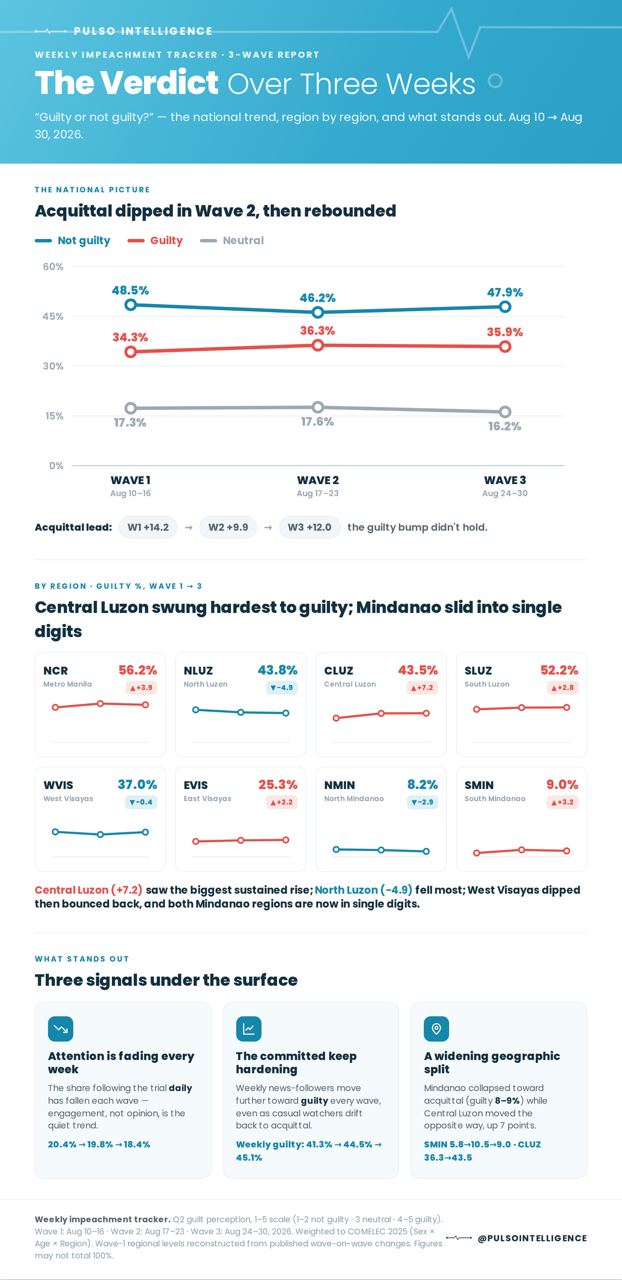
The share of Filipinos who follow the trial daily fell from 19.8% to 18.4% between the weeks of August 17 to 23 and August 24 to 30, while the share saying they are not interested at all rose from 4.4% to 5.1%, according to the third wave of Pulso Intelligence's Weekly Impeachment Tracker. Attention has now declined in every wave of the tracker: daily following stood at 20.4% in Wave 1, 19.8% in Wave 2, and 18.4% in Wave 3.
As attention cooled, the drift toward a guilty verdict recorded in Wave 2 stalled and partly reversed. The share saying the Vice President is not guilty rose from 46.2% to 47.9%, the guilty share eased from 36.3% to 35.9%, and the acquittal lead widened back from 9.9 points to 12.0. The mean guilt rating on the 1 to 5 scale slipped from 2.79 to 2.75.
Among Filipinos who say they are not interested in the trial, the guilty share fell 2.6 points week on week; among those who only occasionally hear news about it, 1.9 points. The committed audience moved the other way: weekly followers edged 0.6 points further toward guilt and daily followers 1.1 points. Because the casual segments are far larger than the committed core, their retreat set the national direction.

“The story of Wave 3 is not persuasion, it is attention. The Filipinos who are still watching moved closer to conviction. Everyone else looked away, and when the casual audience looks away, opinion relaxes back to where it started, which is acquittal,” said Abraham Eleazar D. Quintos, Chief Executive Officer of Pulso Intelligence Labs, Inc.
A week without a bombshell
Unlike Wave 2, whose movement toward guilt coincided with the confidential-funds testimony of witness Gina Acosta, the Wave 3 field week produced no comparable revelation. The Senate hearings continued but coverage was more diffuse, and the tracker’s own attention measures fell. Pulso notes that its design aligns sentiment with events in time and does not prove causation. The most defensible reading is an absence: with no new development to concentrate opinion, the least engaged Filipinos tuned out, and national sentiment drifted back toward its structural resting point.
An indifferent public since July
The tuning-out recorded in Wave 3 is consistent with what Pulso Intelligence found before the tracker began. In a national survey of 2,067 adults fielded July 19 to 22, 2026, 27% of Filipinos could not say whether the Vice President is guilty or not guilty. The survey coincided with the closing days of the prosecution’s presentation of its opening article, the grave threats charge, then the centerpiece of the trial; even so, more than one in four Filipinos took no position at all.
The same July study found engagement that was broad but shallow: 77% of Filipinos said they follow the proceedings mainly through social media, against just 26% through newspapers, and only 21% trusted the Senate to handle the trial fairly. Six weeks later, the tracker is watching that shallow attachment express itself as movement: attention rises when testimony dominates the news, as it did during the Acosta week, and falls back the moment coverage goes quiet, taking verdict sentiment with it.
Skepticism about the process has hardened rather than eased. In Wave 3, only 25.5% of Filipinos say the Senate is conducting the trial fairly, against 37.7% who call it unfair, essentially unchanged from Wave 2 and still net negative.
The senator scorecard: slipping almost across the board
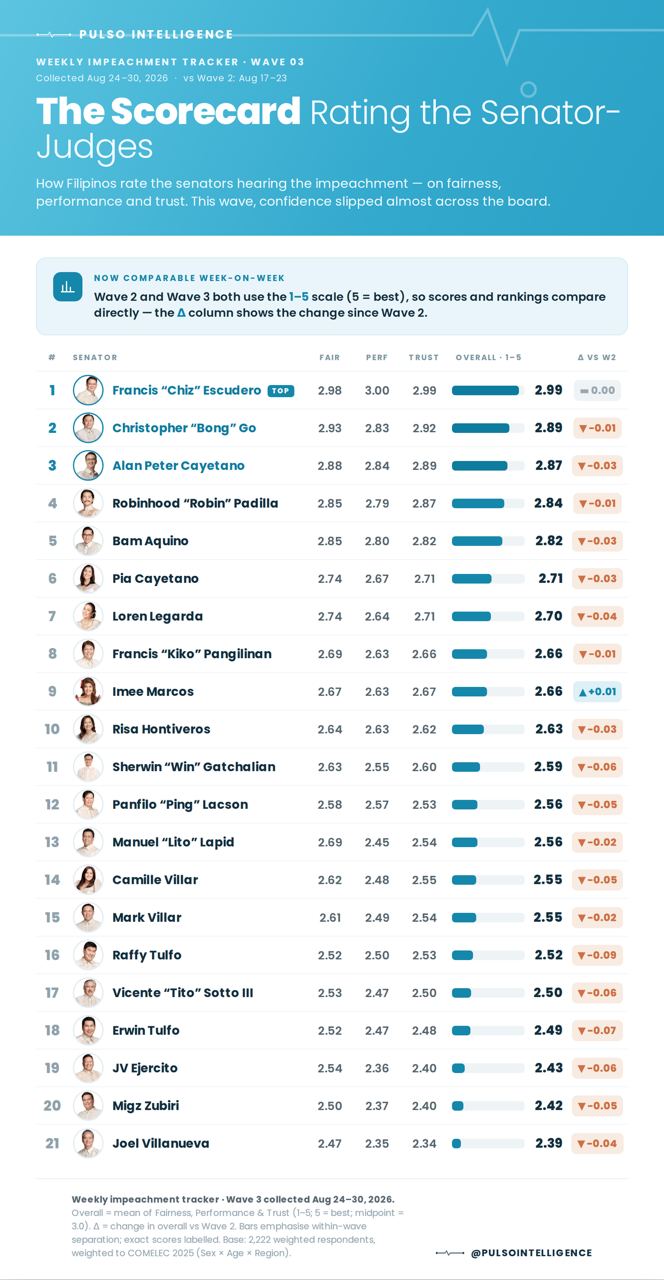
Alongside the verdict question, the tracker asks Filipinos to rate each of the twenty-one senator-judges on fairness, performance and trust; the overall score is the mean of the three.
A note on the scale. Wave 1 rated the senators on a 1 to 3 scale. From Wave 2 onward the battery uses a 1 to 5 scale (5 = best), adopted to capture more nuance than the three-point instrument allowed. Because of the change, Wave 1 scores are not comparable with later waves; only the rank order carries across. Wave 2 and Wave 3 share the 1 to 5 scale, so their scores, and the change between them, are directly comparable.
Two findings define Wave 3. First, no senator clears the 3.0 midpoint of the 1 to 5 scale; the field runs from 2.39 to 2.99. Second, the direction is almost uniformly downward: nineteen of the twenty-one senators lost ground against Wave 2. Only Imee Marcos edged up, by a single hundredth, and Francis “Chiz” Escudero held flat at 2.99, retaining the top spot he has occupied in all three waves. The sharpest declines were Raffy Tulfo (−0.09) and Erwin Tulfo (−0.07).
The rank order has been stable across the series. Escudero, Bong Go and Alan Peter Cayetano have held the top three in every wave, and the bottom of the table has been occupied throughout by the chamber's majority-bloc leadership: JV Ejercito, Migz Zubiri and Joel Villanueva ranked 19th, 20th and 21st in Wave 1 and remain there in Wave 3. The largest mover across the series is Raffy Tulfo, 6th in Wave 1 and 16th in Wave 3. What changed this week is the level, which fell almost everywhere at once, in the same week the public's attention fell. Three sitting senators (Jinggoy Estrada, Rodante Marcoleta and Ronald “Bato” Dela Rosa) are not covered by the scorecard.
Methodology
Wave 3 was fielded August 24 to 30, 2026 through the Pulso Intelligence application, with 2,222 weightable respondents; Wave 2 (August 17 to 23) had 1,684 and Wave 1 (August 10 to 16) 1,500. Results are calibration-weighted to COMELEC 2025 registered-voter benchmarks on sex, age and region; the Wave 3 effective sample size is 1,788.3 (design effect 1.241). The guilt and trial-fairness questions use identical 1 to 5 wording in all waves, where 1 to 2 is not guilty, 3 is neutral and 4 to 5 is guilty. The senator battery moved from a 1 to 3 scale in Wave 1 to a 1 to 5 scale from Wave 2, as noted above. The panel is app-based and opt-in; weighting improves representativeness but does not fully remove self-selection, so week-on-week change is the more defensible statistic than any single absolute level. The July 2026 figures cited are from a separate Pulso Intelligence national survey of 2,067 adults fielded July 19 to 22, 2026, available at www.pulsointelligence.com.
Use and attribution
These results and graphics may be reproduced, quoted, and disseminated freely, including by news organisations, researchers, students, and the general public, provided the findings are attributed to Pulso Intelligence Labs, Inc. and are not presented in a way that misstates them. Full reports are available at www.pulsointelligence.com.
About Pulso Intelligence
Pulso Intelligence Labs, Inc. is an independent public opinion and market sentiment research firm, and the research arm of Geronimo Law. It maintains a verified respondent network of more than 1.6 million panel members across all 17 regions of the Philippines. This survey was designed, conducted, and funded solely by Pulso Intelligence Labs, Inc. No partisan group, candidate, political party, or commissioning interest influenced the survey or the reporting of its results.
Inquiries
Pulso Intelligence Labs, Inc. · c/o Geronimo Law, 610 VGP Center, Ayala Avenue, Makati City · www.pulsointelligence.com